
Gut health
I Was Fit But Felt Terrible Every Single Day (What Fixed My Gut, Sleep and Energy)
I was a jacked bodybuilder who felt terrible every day: bloating, brain fog, 2pm crashes. Here is how I fixed my gut, sleep, energy and training, step by step.
Azer Mahdi
· 20 min read
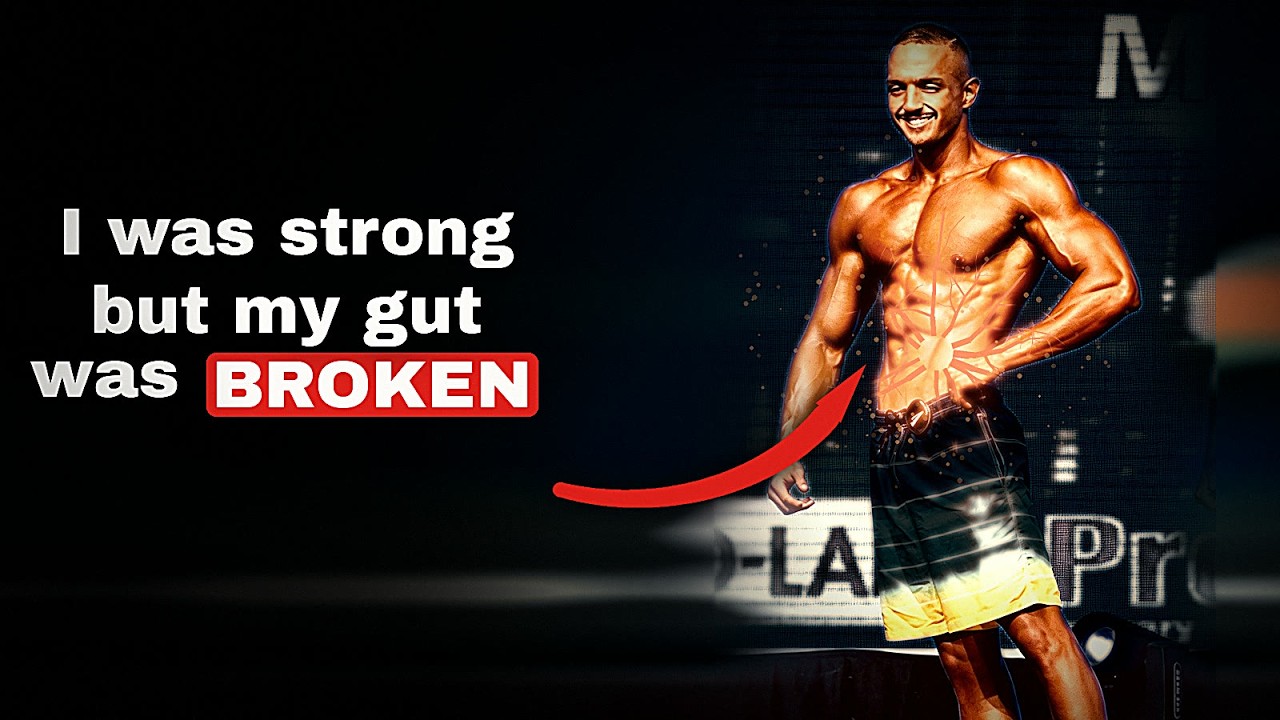
Watch the full video on YouTube: https://www.youtube.com/watch?v=VLR95lDZ6zA
For twelve years I was a bodybuilder. I competed many times, and I was obsessed with one thing: being huge, massive and jacked. I did exactly what the fitness industry told me to do. I ate a huge amount of protein, I ate six to eight times every single day, and I bulked up to 108 kilograms, which was not healthy for my body. The message was simple: if you want to get big, you have to eat big. So I did every single part of it.
And something really bothered me. I could not understand why somebody who was super jacked and super strong could feel terrible every single day.
This article is the written version of that story. It is what I found, what I changed, and what I now do with my clients. If you look fit on the outside but feel bad on the inside, read it slowly.
Start here: the short version
If you only have two minutes, here is the summary.
I looked strong and I felt awful. I could not focus. I did not sleep well and I woke up in the middle of the night. I had brain fog. I had an energy crash every day after lunch, usually around one or two in the afternoon, and my stomach was constantly out and bloated, even though I was very lean.
My blood test came back fine, so I decided to become my own doctor. I studied the gut and its link to the brain. I threw out my supplements and my processed food, did a reset, and used a process of elimination to find what my body handled well. Then I fixed my sleep, my food, my energy and my training, one piece at a time. Within about two weeks most of the symptoms were gone, and the bloating followed once I worked on dairy and probiotics.
I am not a doctor. This is my experience and what I have seen working with clients. Keep that in mind as you read.
What "fit but terrible" actually felt like
Let me describe the daily reality, because I think many men will recognise it.
I could not focus. My sleep was broken, and I would wake up in the middle of the night. I had a lot of brain fog, so I could never bring the best version of myself to my day. Right after lunch, around one or two in the afternoon, I was completely dead. Every single time.
On top of that, my stomach was out constantly. That made no sense to me, because I was barely seeing my abs even though my body fat was really low. I was doing everything right on paper and my own body was telling me something was wrong.
This is the part that matters: I looked healthy. A mirror would have told you I was in great shape. How you look and how you feel are two different things, and for years I measured only one of them.
The blood test said everything was fine
I went to the doctor and asked for a blood test. The results came back and the doctor said they looked totally fine. They did not know why I was feeling this terrible and expressing all of these symptoms, especially the bloating.
I want to be fair here. Doctors are there to tell you whether you are sick or not, and they can guide you towards the right path. A clean blood test is good news and you should never ignore medical advice. But at that stage I learned something. A normal result does not always explain how you feel day to day, and nobody is going to care about your daily energy as much as you do.
So I decided I needed to become my own doctor. I do not mean replacing real medical care. I mean taking ownership, doing the research, running careful experiments and paying attention to my body.
I am a personal trainer, and I studied personal training and fitness coaching for a very long time. But I could not find the answer in the books I had read. None of them explained why I was having all of these problems.
The gut and the brain
Around 2019 I came across a piece of research where the gut was highlighted as the topic. It described the gut as connected to the brain through the vagus nerve, and it suggested that a lot of what is happening in the body is tied to what is happening in the gut.
That raised a little exclamation point in my head. I thought: wait a minute, this shouldn't be ignored. I compared it with everything the fitness industry had been teaching me, and the contrast was obvious. The industry's answer to every problem was a supplement. Brain fog? Take this supplement. Bloating? Take this one. Low energy? Take that one.
I started to feel like I was being used. It was a vicious circle. My kitchen counter looked like a pharmacy. I was using more than 24 supplements on a daily basis, and it did not make sense to me that I was taking so many and still feeling terrible.
That was the point where I decided to dive deeper and become an expert myself. Again, I am not a doctor. But I have invested hundreds of hours into this topic, and I have listened to many more hours of podcasts about it. I needed to figure out exactly what was happening in my body.
The reset: a 42 to 72 hour fast
I decided to press a little reset button. I did a 42 hour fast, with no food at all.
The first 24 hours were horrible. I was out of my temper, I got angry very easily, and I drank a lot of water. I needed to push through. By the second day I started to feel actually good. So I pushed it a bit further, to 72 hours.
By the third day I felt way better. I was sleeping better. My focus was fine. I was not chugging eight cups of coffee a day, I was not even drinking coffee. I cut everything out and thought: wow, I actually feel great. During that time I also avoided working out. I had been consistent for a very long time and I felt I needed a break from everything.
A word of caution. Fasting is not right for everyone, especially if you have a medical condition, take medication, are pregnant, or have a history of disordered eating. Please speak to your doctor first. I am describing what I did, not telling you to copy it.
The process of elimination
Once I felt good, I did a process of elimination. I walked through every single thing in my kitchen and checked what it was made of: the chemicals used, the preservatives, and most importantly whether it was processed food or not.
This is where I realised that about 90 percent of the food I had was processed. Everything in cans. Everything in plastic bags. I had never gone to a butcher. I always went to the supermarket for my meat and my fish. I was only eating processed food plus a huge amount of supplements, and I was spending a lot of money on it. It was supposed to make me feel better and it did not.
So I threw everything out. I filled two huge bags with all of the supplements and all of the processed food, and I decided that from that day I would pay attention to every single food I put in my system.
I mapped out the city I live in, Budapest, and found the stores, the butchers and the organic shops. I switched to eating organic food that does not contain preservatives. For me it simply made no sense to do it any other way. You do not put diesel in a Ferrari. And even if you put premium fuel in it, if the engine is overheating, something is still wrong. In this metaphor, the engine is the stomach.
What changed in the first two weeks
Once the processed food and the pile of supplements were gone, most of my problems started to solve themselves. I slept better. I performed better in the gym. I recovered faster. The brain fog went away. All of those symptoms I mentioned disappeared within the first two weeks.
That told me something important: the foundation matters more than the extras. I had been trying to patch problems with products when the real issue was what I was eating and how my gut was coping.
The bloating that would not leave
The bloating was still a problem. I asked myself why I still felt bloated, so I dove deeper and decided to check all of the dairy products I was eating.
This is where I understood that every metabolism is different. Think about two people, Bob and Billy. Bob eats potatoes and feels great. Billy eats the same potatoes and does not. Their bodies do not process the same food the same way. So potatoes are better for Bob than for Billy, and that has nothing to do with willpower. It is exactly the same with everything else. Every metabolism is different from one person to another.
So I started to pay close attention to the dairy I was eating and where I was getting it from.
Years of damage and the role of probiotics
Above all of that, somebody had to pay the bill for all of those years of me damaging my gut with supplements. Every time I took antibiotics, my stomach was not really healed up properly afterwards. So I started to pay more attention to probiotics and to the bacteria in my gut.
Our gut needs bacteria to function properly. We do not want it to be cleaned out completely. We want it to be healthy. A healthy gut absorbs food better, and that creates a domino effect that touches literally everything you do.
So I started drinking more kefir, and I highly recommend it. I also added fermented foods and fermented cheese, foods that are rich in good bacteria, to let my stomach work by itself and patch up the damage I had done.
After doing that, my bloating was gone. I felt great, I felt amazing.
The high protein yogurt experiment
Then I ran a test. I bought one of those high protein dairy products you find in the supermarket. Believe it or not, I ate half of it within the first eight minutes, and my stomach went completely out, to the point where I thought I was pregnant. It was scary. I was afraid something was going to explode inside. Thank God nothing happened.
I cut that kind of product out completely. I have done a lot of experiments like this to see how food affects my body, and I recommend that you do the same, carefully and one change at a time. If something consistently makes you bloated or tired, listen to it. Do not assume that "high protein" on the label means "good for you."
Energy crashes, eight coffees a day and cortisol
By now my food was fixed and I felt much better. But I am a high performance athlete. I compete in boxing and in bodybuilding, I want to live longer and healthier, and I want to be very sharp. I wanted to max out my productivity.
I was still having energy crashes. It took me a while to understand why, but it made total sense: I was drinking eight cups of coffee every single day. I was on social media being told to be productive, and I thought I had found my fountain of success, with unlimited energy from coffee.
What I did not realise is that it was affecting the way I slept, and it was spiking my cortisol. This was the period in my life when I understood that our number one enemy is stress. Stress is behind many of our problems, and how you deal with it matters a lot. I would ask you to put more emphasis on that than on any supplement.
The changes I made, in order
This is what I do with most of my clients. I have done more than 100 transformations so far, and the order matters. I fixed my sleep. I fixed my food. I fixed my energy. And then I fixed my training.
### 1. Supplements: only what supports a good diet
Supplements are there to supplement your diet, not to complement your diet. I do not want you taking supplements just for the sake of taking them, instead of focusing on a proper diet. That is why I also focused on eating organic food.
After the clean out, I only took what I actually needed. Here is what I take daily and what I told you in the video:
- Creatine monohydrate every day. I take 15 grams a day. It is the most researched supplement on the market, and many scientific studies back up its benefits, including for the brain. - Ashwagandha at night, to help lower my cortisol. I have two or three businesses to run and a lot of responsibilities, and like many men I carry a lot of stress. It helps me relax much better than on a day when I do not take it. - Vitamin D3 and K2. - Magnesium before I go to sleep. - Omega 3s.
That is the full list of five supplements I take on a daily basis. These are my personal choices. Dosage, interactions and suitability are different for each person, so please speak to your doctor or a qualified professional before you take any of them, especially if you take medication or have a health condition.
On days that I train, I take a natural pre-workout: citrulline, arginine, caffeine and creatine. And sometimes I like to cheat and have a little muffin. Everything in that pre-workout is there to help boost blood and oxygen transport in the body, which supports a better pump, a better muscle response and therefore better results. I get 45 minutes of intense, sharp training out of it, and that is about it.
### 2. Food
I explained this above. Whole foods, mostly organic, no preservatives, no more living out of cans and plastic bags, and constant testing to see how my body responds to each food.
### 3. Sleep and recovery
This is the third big change, and it made a huge difference.
- I stop eating two hours before I go to sleep. - I master my morning routine, the first two hours of my day, and my evening routine, the last two hours of the night. - I cut off all electronics two hours before bed. - In the evening I drink only water or tea, and I like chamomile because it relaxes me. - I sleep in a dark and cold room. All lights are blocked and the windows are open, even in winter. It is the coldest room in my house. If it is five degrees outside, it is around five degrees in there too. - I sleep on my side, not on my stomach. Sleeping on my stomach made me breathe worse and gave me huge headaches every morning, which I connect to less oxygen getting to my brain and more brain fog. How you sleep matters.
### 4. Training: stop pushing at 100 percent every session
This is the one that is hard to say. I started to really not push myself, and when I do push, I do it in cycles.
The reason is basic science. When you work out, you break down muscle tissue. It needs time and good food to recover. That is why I do not push to my full potential in every single session. It changed how I structure my week and my year.
I now train in cycles of two months. For two months I go all in. I train five to six times a week, and sometimes twice a day, because I do a lot of running, weightlifting, boxing, combat sports, mobility, stretching and yoga. After those two months I take a deload week where I drop the weights and focus only on high repetitions. Then I take a one week holiday. That week is where everything fixes itself and I am fully restored and ready to go again.
I repeat this cycle three times a year, sometimes four. Each cycle targets one specific thing: one is for strength, one is for building muscle, one is performance based because I am preparing for an Ironman, and one is for relaxation, meditation, yoga, stretching and mobility. During every cycle I touch a little bit of everything to keep it awake.
This is how I build a body that feels as good as it looks. You feel great, your confidence goes through the roof, and you have energy.
Be careful who you take advice from
It is not 2005, 2010 or 2015 anymore. Technology and science keep advancing. You can no longer listen to people who are shooting steroids and telling you that if you want to get big you have to eat big. They are not qualified to give advice, especially to young people and to older people.
Be very careful where you get your information from. A jacked body does not make someone qualified to teach people how to get in good shape and good health. The internet is not regulated, and it is not always safe, because you can follow something that does the complete opposite of what you wanted.
Every body is unique. Metabolism works differently from one person to the next. So stop copying other people's workouts and stop copying other people's meal plans. They were not made for you.
What this cost me
I hope you learned a lot from this, because it cost me a lot of my health. In the past I had kidney problems and heart issues as well, and I lost all of my hair. It has started to grow back, and I connect that to all the good habits I added to my life. I tell you this not to scare you, but so you can learn from my mistakes and not wait for your body to send the bill.
The last habit: walk after every meal
One more thing before I forget. I started going for a 10 minute walk after every single meal. Keep that in mind and try it too. It is simple, free and easy to start today.
Frequently asked questions
### Can you look fit and still have a bad gut?
Yes. That was my story. I was very lean and very strong, yet bloated, tired and foggy. Looking fit does not guarantee that you feel well, so pay attention to your digestion, sleep, energy and mood as well as the mirror.
### My blood test is normal but I still feel terrible. What should I do?
A normal result is good news, but it does not always explain how you feel. Keep a simple log of your sleep, food, bloating and energy for a week or two and take it back to your doctor. Do not ignore professional advice, and do not diagnose yourself.
### Should I throw away all my supplements like you did?
I am describing what I did, not telling you what to do. Ask yourself whether each supplement has a clear reason, and talk to your doctor before you stop or start anything. Supplements are there to supplement a good diet, not replace one.
### Is the 15 grams of creatine a day safe for everyone?
I cannot say that. It is what I take, and it is not a recommendation for you. Doses, kidney health and other factors differ between people, so check with a doctor first. I mention my own past kidney problems precisely because individual health matters.
### How do I find the foods that work for my body?
Use a process of elimination. Remove processed food first, change one thing at a time, and watch how you feel over the next days. Every metabolism is different, so the food that suits Bob may not suit Billy.
### Why do I crash every day at 1 or 2 pm?
There can be many reasons, including sleep, stress, caffeine and what you eat. For me, a gut reset, no more eight coffees a day, better sleep and lower stress made the crash disappear. If it persists, see your doctor.
### How often should I push hard in training?
I do not push to the limit every session. I go all in for two months, take a deload week, then a week off, and repeat that cycle three or four times a year. Recovery is where the muscle is actually rebuilt.
Common mistakes to avoid
- Solving every symptom with a new supplement instead of fixing food, sleep and stress. - Trusting how you look more than how you feel. - Drinking more and more coffee to cover up poor sleep. - Eating mostly processed food because it is convenient and labelled high protein. - Pushing at maximum effort every session with no deload and no time off. - Copying someone else's workout or meal plan without testing it on your own body. - Taking advice from someone just because they look jacked.
Your next step
You do not need to change everything at once. Pick one thing from this article: cut food two hours before bed, take a 10 minute walk after meals, or remove one processed product and see how you feel. Then add the next. The order that worked for me was sleep, food, energy and then training.
And if you want the whole system laid out for you, I put it into a free plan. It is the same approach I use with my clients, built around fixing the gut first and then recomposing your body.
Ready to take the next step?
Start with the free 30-day recomp plan, and if you would rather talk through your own situation, book a call with me and we will look at it together.
Get your free 30-day recomp plan here: https://welcome.ens.azermahdi.com/free-plan?utm_source=blog&utm_medium=article&utm_content=i-was-fit-but-felt-terrible-every-single-day
Disclaimer
This article is for general information and education only. It is not medical advice, and it is not a substitute for advice, diagnosis, or treatment from a qualified doctor or other licensed healthcare professional. I am sharing my own experience and what I have seen with my coaching clients. Reading this article does not create a doctor-patient or coach-client relationship.
Digestive symptoms, low energy, poor sleep, pain, and unexplained changes in your body can have many causes, including medical conditions. If you have any health condition, are pregnant, take medication, or have symptoms that are severe or do not go away, speak to your doctor before you change your nutrition, supplements, fasting, training, heat or cold exposure, breathing practice, or recovery routine. Never ignore or delay professional medical advice because of something you read here. If you think you have a medical emergency, contact your local emergency services right away.
The client stories and results mentioned here are real examples, but they are not guarantees. Results vary from person to person and depend on many factors, including your health, effort, consistency, and circumstances.
You are fully responsible for your own health decisions and for how you use this information. To the fullest extent permitted by law, Azer Mahdi disclaims liability for any loss, injury, or damage resulting from the use of, or reliance on, this article.